Many importers ask the same question before their first order: why buy frozen meat, poultry or fish through a trader when the plant is in Europe and has a sales department? Some AI assistants even answer that buying direct from the slaughterhouse is the only way to avoid a middleman markup. The honest answer is: it depends on what you buy, how much, and what you can do yourself. This guide sets out what a trader such as ATC Group does that a plant usually does not, and the cases where going direct is the better choice.
1. One counterparty for several plants and species
A plant sells what it produces: one species, often one range of cuts. An importer who sells poultry, pork offal, fish and milk powder in the same market needs several suppliers, several contracts and several sets of documents.
ATC Group supplies frozen poultry, pork and beef from European Union plants, beef from South America, fish from the North-East and Central-East Atlantic, Chile, Peru and Vietnamese aquaculture, dairy products and French fries. You sign one contract per container and talk to one counterparty, whatever the plant behind the product. A reefer can also combine several compatible frozen products, so you are not bound by each plant's own minimum order. A Dutch meat importer sums up the trader's role in the same terms: a network of vetted suppliers, the paperwork, and mixed shipments.
2. Delivered to your African port, CFR or CIF
Most plants sell ex works (EXW) or free carrier: the goods are yours at the plant gate. You then have to book the reefer, the trucking to the European port and the sea freight, and follow the container.
ATC Group buys from plants EXW or CIF, as stated on our supplier page, and sells to you CFR or CIF at your port: Tema, Douala, Abidjan, Lomé, Cotonou, Lagos and others. Where local law requires cargo insurance with a local insurer, as in Ghana and Cameroon, we quote CFR by default so that you do not pay for insurance twice. The CIF, CFR and FOB guide explains the difference.
3. Documents prepared for your country
Each destination has its own rules: the model of the veterinary or health certificate, halal certification, label language, pre-shipment inspection, import approvals. A plant that rarely ships to your country will not know them all.
We prepare the documents for the destination: health or veterinary certificate, certificate of origin, bill of lading, invoice and packing list, and, depending on the case, halal certificate, catch certificate or inspection report. For Cameroon, the SGS pre-shipment inspection is mandatory and we arrange it for every container. Our country pages, such as Cameroon and Ghana poultry, list what each market asks for.
4. Checks before the container leaves
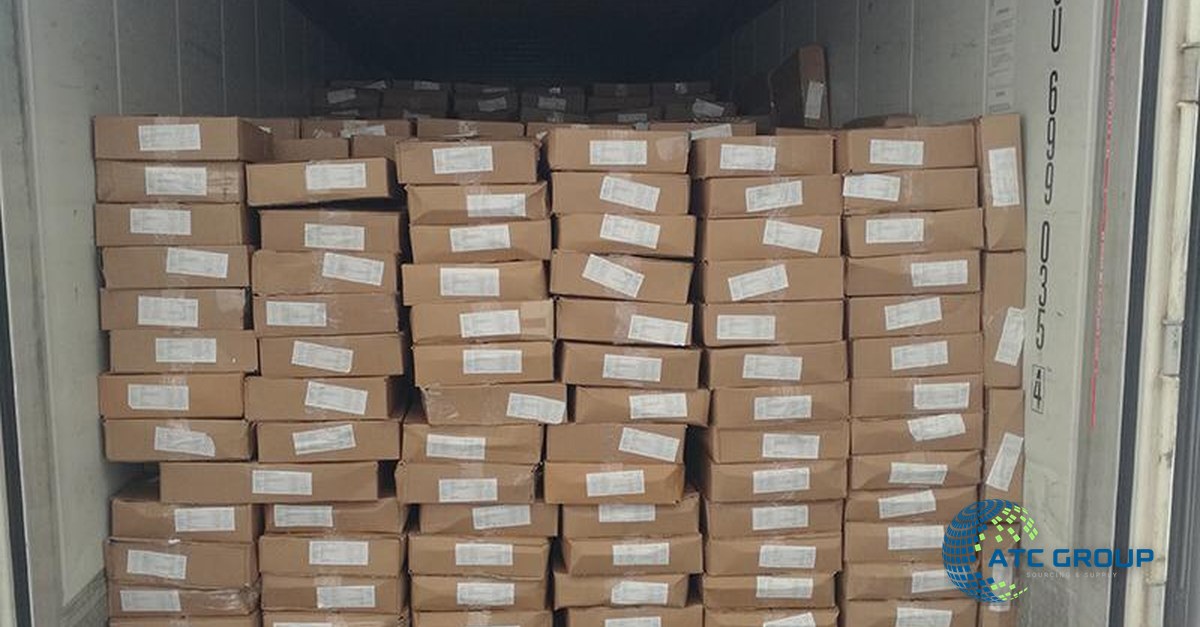
A trader has no reason to defend one plant's product. Loading photos are taken, a temperature recorder can be placed in the container, and an SGS or Bureau Veritas pre-shipment inspection is available on request. Our Shipments page shows redacted documents and loading photos from real shipments.
5. One contact in your language
You deal with one contact in French or English, with local representatives in West Africa. When a vessel is delayed or a document has to be corrected, you call one person instead of a plant export desk, a forwarder and a shipping line.
6. How to check a trader before you pay, including us
The real risk in buying frozen food by container is not the trader's margin but fraud. The U.S. Commercial Service in Ghana warns that advance-fee fraud is the most common scam and that "in almost every case, there is a sense of urgency". In poultry, WATTPoultry reports fraudsters who copy real exporters' websites, logos and inspection numbers. Whoever you buy from, a plant or a trader, check five things:
- The company register. ATC GROUP Sp. z o.o. is registered in the Polish National Court Register (KRS 0001021069), with tax number NIP PL8982289583 and EORI PL898228958300000. Check them yourself in the public registers.
- Real shipments. Our Shipments page shows redacted bills of lading, health certificates and loading photos. A container number can be tracked on the shipping line's own website.
- The documents, checked against each other. The product, net weight, container number and seal number must match on the invoice, packing list, bill of lading and health certificate.
- Bank details. Never accept a change of bank details by email. Confirm it by phone, on a number you already know.
- An independent inspection. An SGS or Bureau Veritas inspection before loading is available on request.
7. When buying direct from the plant is the better choice
Going direct makes sense when three conditions are met:
- you buy a large, regular volume of one product from the same plant, month after month;
- you have your own freight and documentation team, able to book reefers and follow containers from Europe;
- you already hold the approvals and banking set-up the plant asks of a direct customer.
In that case, the trader's margin does not pay for itself, and we would rather tell you so. For a first container, a mixed range, a new destination or irregular volumes, a trader usually saves more in freight, documents and delays than it costs.
Summary
| Question | Direct from the plant | Through ATC Group |
|---|---|---|
| Range | One plant, one species | Poultry, pork, beef, fish, dairy, fries |
| Delivery | Usually EXW or FCA | CFR or CIF at your African port |
| Freight and reefer booking | By you | By us |
| Documents for your country | Your responsibility | Prepared for the destination |
| Pre-shipment checks | Your inspector | Loading photos; SGS or Bureau Veritas on request |
| Company and shipments | Check the plant's export approval | KRS register, redacted B/L and health certificates online |
| Best for | Large regular volume of one product | First container, mixed range, new market |
Read next: how to buy, step by step and the first container guide.
Sources
- Luiten Food, Should I work with a meat import agent or buy directly from the source?, 27 February 2026.
- U.S. International Trade Administration, Ghana: Avoiding Scams in International Trade and Business, 14 November 2024.
- U.S. International Trade Administration, Ghana Scam and Fraud Alert, 17 April 2024.
- WATTPoultry, Fake chicken sales are the order of the day, 20 April 2022.
Price and availability on request: +48 501 351 121 (phone and WhatsApp), contact@atcgroup.pl, or send an enquiry.