In 2026 the dairy market split in two. Butter and cheese fell; skimmed milk powder went the other way. According to FAO, in October 2026 skimmed milk powder (SMP) prices were 45.8% higher than a year earlier, while the FAO Dairy Price Index was 16.9% lower.
For an importer who reconstitutes milk, makes yoghurt or packs powder for retail, the question is no longer whether SMP is expensive, but how to buy for the first half of 2027 without paying the top of the market or running short.
Why SMP rises when butter falls
Butter and skimmed milk powder come from the same litre of milk: the dairy separates the cream, churns the fat into butter and dries the skimmed milk that is left. You might expect more butter to mean more powder, and prices moving together.
In practice each product has its own buyers and its own stocks. In 2026 milk fat was plentiful while demand for dairy protein stayed firm. Butter fell while SMP rose. Higher milk collection alone is not enough to predict the powder price.
What happened, region by region
European Union: more exports despite higher prices
In mid-September the European Commission reported EU SMP prices up 33.4% year on year. European dairies still gained market share: in January-May 2026, extra-EU SMP exports rose 11%. Shipments to Egypt doubled (+104%), Indonesia (+21%) and Malaysia (+24%) took clearly more, while Algeria (-3%) and Saudi Arabia (-1%) bought slightly less.
United States: American powder loses ground
In the United States, powder (NFDM, nonfat dry milk) became expensive against competing origins. US exports of NFDM and SMP totalled about 321,700 tonnes in the first half of 2026, down 3%: the weakest first half since 2017, according to the U.S. Dairy Export Council. Mexico, the main outlet for US powder, also bought less (-6%).
Oceania: the GDT auction confirms the trend
At the Global Dairy Trade auction of 17 November the overall index was unchanged, but the SMP index gained another 2.2%. New Zealand is coming off a record 2026 milk season, which was not enough to ease the powder market.
Asia and the Middle East: buyers booking early
China is building up local production, which reduces its needs without taking its importers out of the market. In South-East Asia, Indonesia and Malaysia are taking more European powder. In the Middle East and North Africa, local milk does not cover industry needs, and public and private powder purchases weigh on availability months in advance.
2027: a correction is possible, but limited
Three forces will pull in different directions.
- Slower milk supply. In September Rabobank expected production growth in the seven main exporting regions to slow to 0.5% in the second half of 2026, then output contracting in the fourth quarter and broadly flat through the first half of 2027. Less milk means less powder.
- High prices curbing demand. After such a rise, some buyers cut volumes, replace part of their SMP or wait. That is what could allow a correction in spring.
- Weather. Rabobank names El Niño as a downside risk for New Zealand production, which depends heavily on pasture. Its actual impact cannot be measured today.
Behind these sits a longer trend: demand for dairy protein (sports nutrition, high-protein foods) is leading some dairies to turn skimmed milk into protein concentrates rather than standard powder.
Our reading: lower prices in 2027 are possible, but betting everything on them would be risky. The most likely scenario is a market that stays firm for near deliveries and eases slowly for later ones.
What we recommend to importers
- Do not buy the whole first half at once. Split your bookings: cover part now so you are not short, and book the rest later if the market eases.
- Compare origins on the same basis. Same specification, same Incoterm (CIF or CFR, same port), same loading date. A price gap often hides a difference in specification or timing.
- Check the specification, not just the name. For SMP: protein in non-fat solids (34% minimum is the usual reference), moisture, scorched particles, absence of antibiotics, microbiological results. Ask for the lot's certificate of analysis before loading.
- Consider fat filled milk powder (FFMP) where the use allows. For reconstitution and some dairy products, FFMP can replace part of the milk powder; our FFMP buyer's guide explains the differences.
- Take care of storage. Powder keeps for a long time, but only cool and dry: a hot, humid warehouse shortens its real shelf life and causes lumps.
Skimmed milk powder at ATC Group
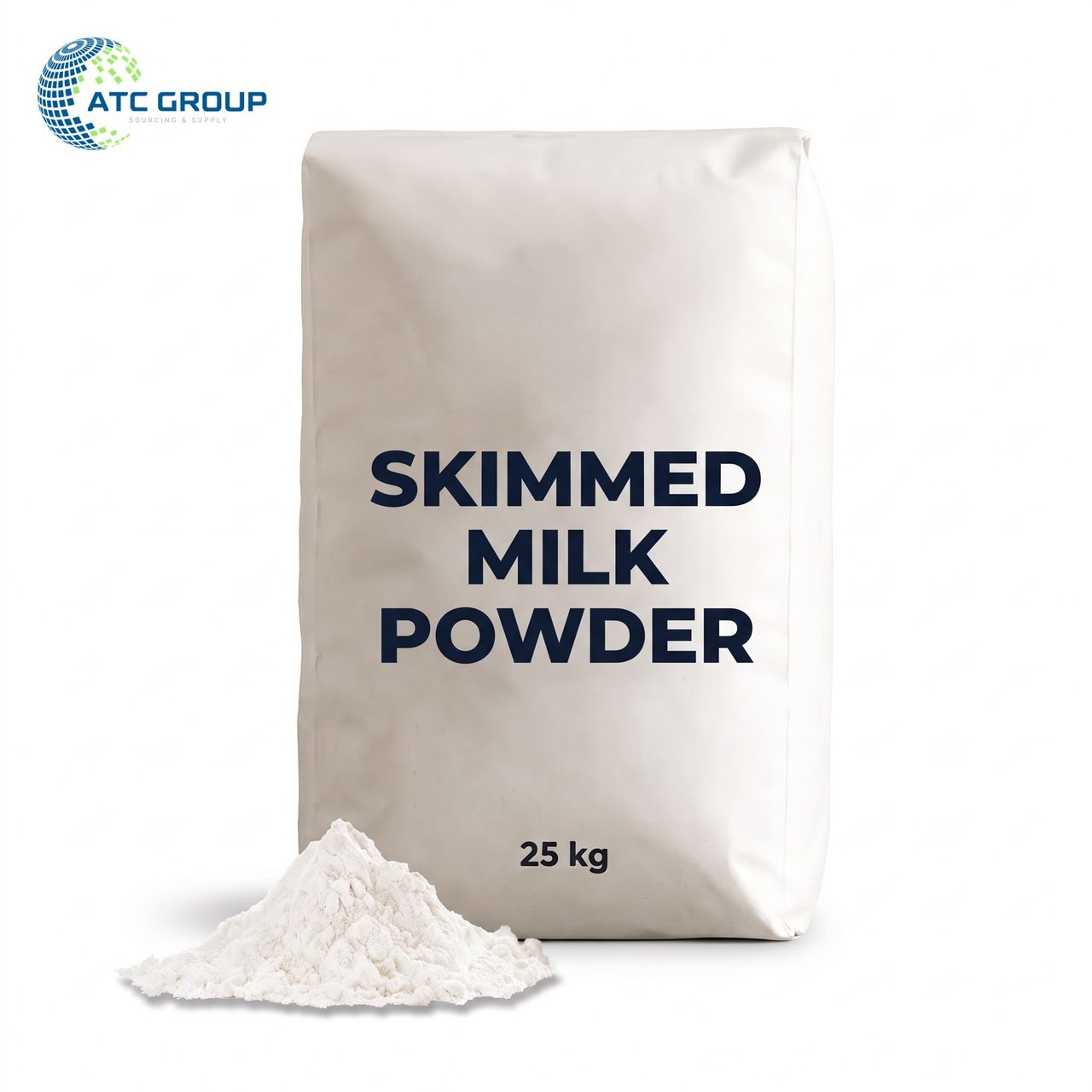
ATC Group supplies spray-dried skimmed milk powder, minimum 34% protein in non-fat solids, of European Union origin, from approved plants.
- 25 kg paper bags with polyethylene liner; big bags on request.
- 24 tonnes per 40' container (960 bags).
- Shelf life 24 months from production, stored dry at 20 °C or below.
- Documents with every shipment: certificate of analysis, veterinary health certificate, certificate of origin; halal on request.
- Sold by full container, CIF, CFR or FOB.
Price and availability on request: +48 501 351 121 (phone and WhatsApp), contact@atcgroup.pl.
Figures are those published by the sources below at the date of this article (26/11/2026). Futures and forecasts reflect market expectations, not guaranteed prices.
Sources
- FAO, Food Price Index, October 2026, reported by Food Ingredients First, 09/11/2026: https://www.foodingredientsfirst.com/news/fao-food-prices-october-2026.html
- European Commission, Milk Market Situation (update of 17/09/2026): https://agriculture.ec.europa.eu/document/download/a8ba30c6-253c-4a73-bb42-5c057cbddc3e_en?filename=milk-market-situation-factsheet_en.pdf
- U.S. Dairy Export Council, first-half 2026 exports, reported by The Cattle Site, 21/08/2026: https://www.thecattlesite.com/news/us-milk-powder-exports-hit-weakest-first-half-since-2017
- Global Dairy Trade, auction of 17/11/2026, reported by Agriland: https://www.agriland.ie/farming-news/gdt-index-unchanged-as-butter-and-cheddar-fall-back/
- USDA FAS, Dairy: World Markets and Trade (July 2026): https://apps.fas.usda.gov/psdonline/circulars/dairy.pdf
- Rabobank, Global Dairy Quarterly Q3 2026, 09/09/2026: https://www.rabobank.com/knowledge/q011332988-global-dairy-quarterly-q3-2026-a-market-in-transition
- Rabobank Australia, press release of 15/09/2026: https://www.rabobank.com.au/news/media-releases/2026/slowing-milk-supply-and-growing-protein-demand-reshape-global-da