
Côte d'Ivoire imports most of the fish it eats. Import volumes rose from about 388,000 tonnes in 2015 to more than 732,000 tonnes in 2024, according to Agence Ecofin. Chile is now the leading supplier, ahead of Peru, Senegal and Mauritania. For an importer buying full containers, the margin depends as much on paperwork as on the purchase price: a container held at the port costs storage and reefer power every day.
Here are the steps, in the order they come.
1. Before ordering: the importer's approvals
- Importer approval for products of animal origin, granted after review by an interministerial commission (Ministry of Animal and Fisheries Resources, MIRAH). For dairy products the same procedure costs 100,000 FCFA per file and the approval is valid for one year; commissions meet twice a year, so plan ahead.
- Import-export code, issued by the Directorate of Foreign Trade and renewed every year.
- Import declaration (FDI), required above 500,000 FCFA FOB value and valid for three months.
- Prior import authorisation (API), listed among the documents for the sanitary inspection on arrival.
2. Before the vessel sails: the exporter's documents
- Health certificate from the country of origin, issued for an approved plant.
- Certificate of origin, commercial invoice, packing list and bill of lading.
- Cargo tracking note (BSC), run by the Office Ivoirien des Chargeurs (OIC). It is mandatory for every sea shipment discharged at Abidjan or San Pedro and must be validated at least five days before the vessel arrives. Without a validated BSC, the cargo is not released.
- Insurance taken out locally by the importer, required with the FDI for the BSC.
The usual weak point is not the exporter: it is the importer's FDI and insurance certificate, which often arrive last. Sending them as soon as the booking is confirmed avoids missing the BSC deadline.
3. On arrival: the veterinary inspection at the port
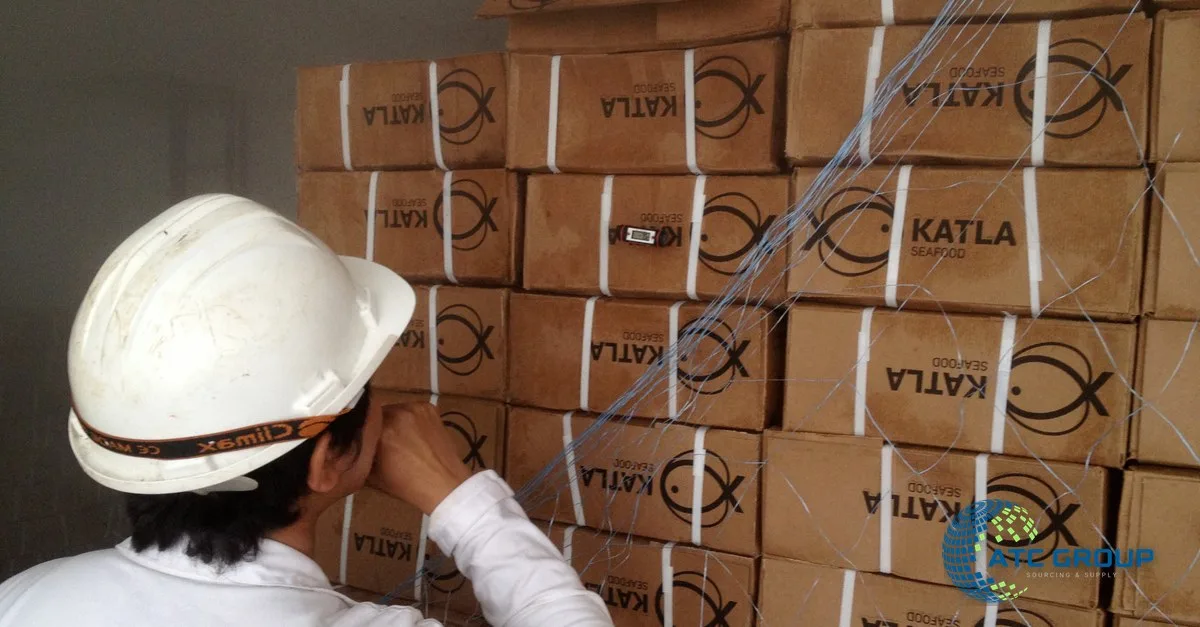
MIRAH veterinary officers inspect the cargo with a customs officer present:
- check of transport references, packaging, importer and supplier names;
- check of production and freezing dates, health mark, product type and storage conditions;
- six cartons sampled at random from the front, middle and back of the container;
- sensory, microbiological and chemical tests at the central laboratory (LCHAI). For fish, results come back within one day.
If everything complies, the importer receives the health clearance certificate (certificat de salubrité), free of charge, together with the sanitary pass (laissez-passer sanitaire).
4. Product requirements
- Cold chain at -18 °C or below throughout, with a brief surface tolerance up to -15 °C.
- Labelling: product name, species, expiry date, producer details, health mark, lot number, origin, size grade and net weight. One species per lot.
5. Five checks to make yourself when the container is opened
Before signing for delivery, experienced importers check:
- The container temperature log for the whole transit, not only the display on arrival.
- Core temperature, -18 °C or below, on cartons taken from the back and near the doors.
- Carton condition: heavy frost or cartons stuck together point to a break in the cold chain.
- Labelling, carton by carton, against the packing list.
- Matching documents: health certificate, certificate of origin, packing list and bill of lading.
6. Lead times
Allow two to three weeks between booking and loading, then 23 to 26 days at sea from Northern Europe to Abidjan, before customs clearance. For sales before the year-end holidays, the container should be loaded by around 10 November.
How ATC Group works
ATC Group is a B2B trader and frozen fish supplier: we sell frozen fish by full 40' reefer container, CIF or CFR Abidjan and San Pedro. The fish comes from approved plants in the European Union, Chile and Peru, and from farms in Vietnam and China. We prepare the health certificate, certificate of origin and BSC documents with the supplier.
Price and availability on request: +48 501 351 121 (phone and WhatsApp), contact@atcgroup.pl.
The rules quoted are those published at the date of this article; check current amounts and deadlines with your freight forwarder before each shipment.
Sources
- Agence Ecofin, « Côte d'Ivoire's fish imports nearly double over the past decade », 23/02/2026 : https://www.ecofinagency.com/news-agriculture/2302-53156-cote-divoires-fresh-fish-imports-nearly-double-over-the-past-decade
- Guichet unique du commerce extérieur de Côte d'Ivoire (GUCE), fiche « Certificat de salubrité à l'importation » : https://gucecotedivoire.ci/pwic/wp-content/uploads/GUIDE_INTERACTIF/DOCUMENTS/CER002_CERTIF_SALUBRITE_IM_.pdf
- Service public de Côte d'Ivoire, « Importer du lait et ses produits dérivés » (agrément, coût, validité) : https://servicepublic.gouv.ci/accueil/detaildemarcheparticulier/2/311/98
- Guide des normes d'importation de viande et de poisson congelés en Côte d'Ivoire, janvier 2025 : https://www.aidersoigner.com/viande-et-poisson-congele-le-guide-des-normes-dimportation-en-cote-divoire/
- BSC Côte d'Ivoire (OIC), délais et obligations : https://getctn.com/ivory-coast-bsc